
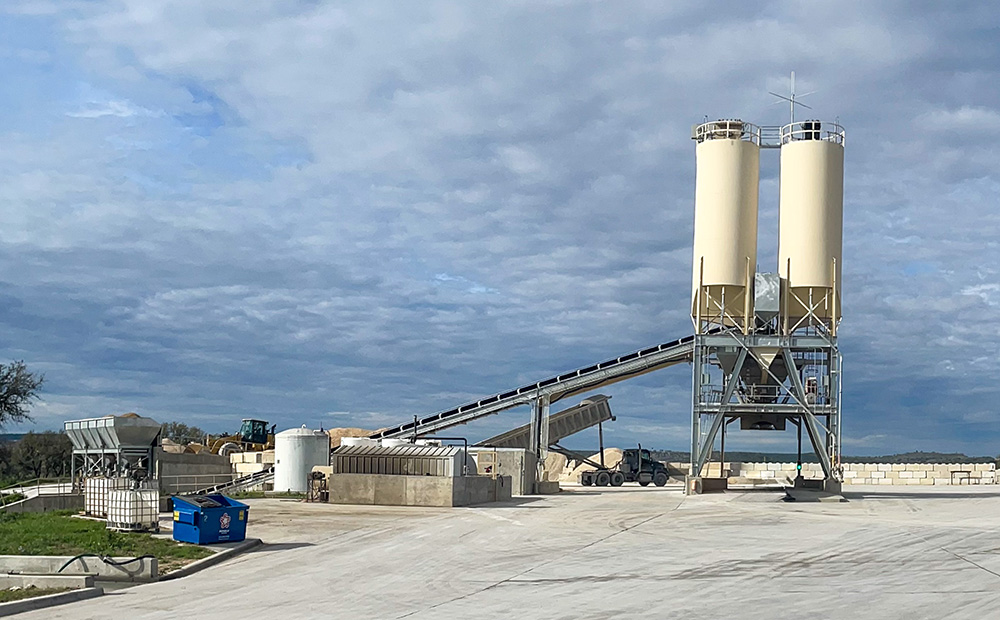
A 20-Year Industry Veteran’s Take on the Advantage 250™
With more than two decades in the concrete industry, Anthony Letterman has seen just about every type of batching system in operation. Over the course of his 20-year career in North Carolina, he spent 15 years working with traditional repose batch plants — 10 years in central mix operations and 5 years in dry batch — before transitioning to the Advantage 250™ Concrete Batch Plant, where he logged five years of hands-on experience.
That depth of experience makes his perspective especially valuable — and his conclusion is clear: precision inline aggregate blending isn’t just different, it’s better.
According to Letterman, one of the most immediate advantages of the Advantage 250™ is the improved working environment and material handling. Inline blending significantly reduces dusting compared to traditional repose batching, creating a cleaner, more efficient plant operation. It also delivers a noticeably quieter plant. Without clam shell gates and without free-falling material, the harsh, jarring noise typical of traditional plants is dramatically reduced.
“During the batching process, the loudest part of it all is the truck,” Letterman says.
But the real impact shows up in the concrete itself.
“The mix consistency is better,” he explains. “The blended material cuts down on slump times.”
That kind of consistency isn’t just convenient — it’s transformative. Faster load times mean improved truck cycle efficiency, tighter scheduling, and greater overall plant productivity. And when it comes to output, Letterman confirms that the Advantage 250™ delivers exactly what it promises.
“Yes,” he says confidently when asked if the plant can truly achieve 250 cubic yards per hour. “The speed that you can load a truck is a game changer.”
Despite its advanced technology, the system doesn’t add complexity where it matters most. Calibration, often a concern when adopting new plant systems, is straightforward.
“It’s easy to calibrate the plant with the central scale in place,” Letterman notes — dispelling the notion that inline blending plants are difficult to calibrate.
Control systems are another area where the Advantage 250™ stands apart. Having worked with other industry-standard platforms, Letterman found the transition to Jonel controls to be not only smooth, but a clear upgrade.
“Jonel is far superior… very easy to learn, and customer support is always there to help.”
After five years operating the Advantage 250™, Letterman’s assessment is rooted in real-world performance, not theory. From quieter, cleaner operation and superior mix quality to faster load times and dependable high-volume output, the plant delivers measurable advantages across every aspect of production.
For producers evaluating the next step forward, his experience says it plainly: once you’ve run an Advantage 250™, it’s hard to look at traditional batching the same way again.