
Across the Texas Hill Country, concrete producers face unique challenges. From rapidly growing communities around Kerrville to expanding commercial development throughout Central Texas, today’s ready-mixed concrete suppliers are expected to deliver greater volumes of concrete while maintaining exceptional consistency from one load to the next.
Meeting those expectations requires more than increasing production capacity. It requires improving the batching process itself.
Why Aggregate Blending Matters
Every concrete mix depends on a carefully engineered combination of coarse and fine aggregates. Even when a mix design contains only two or three aggregate sizes, how those materials are combined has a significant impact on the finished concrete.
Traditional repose batching weighs each aggregate individually, allowing the materials to free-fall into a common weigh hopper. As the materials accumulate, they naturally separate according to particle size. Larger stone tends to roll outward while finer materials settle differently, creating localized segregation before the batch even reaches the mixer.
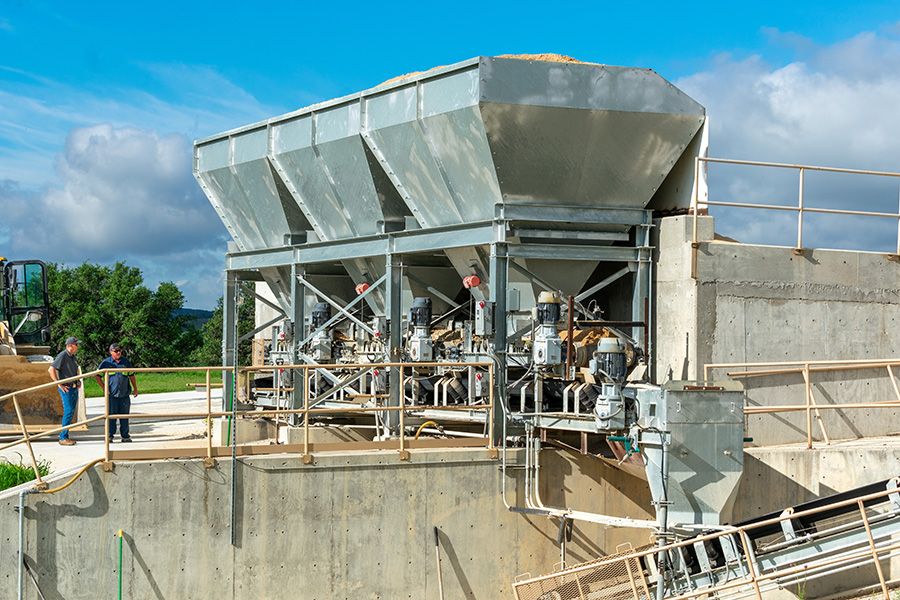
The Advantage 250™ concrete batch plant from CMQ Engineering takes a different approach.
Rather than batching aggregates one at a time, each aggregate is weighed simultaneously on its own dedicated weigh belt. The materials are then discharged together in continuously layered ribbons onto the charging conveyor, creating an inline blend before entering the mixer. This process produces a more uniform aggregate distribution throughout the entire batch while minimizing segregation and reducing internal voids. The result is denser aggregate packing, more consistent concrete, and improved repeatability from load to load.
An additional benefit is production speed. Because all aggregates are weighed simultaneously instead of sequentially, the batching cycle is significantly shorter than with conventional repose systems. Faster batch cycles allow producers to load more trucks per hour while maintaining the precision demanded by today’s construction projects.
Moisture Control: The Hidden Variable
Another critical factor in producing consistent ready-mixed concrete is sand moisture.
Moisture content can change dramatically throughout the day due to rainfall, drainage, humidity, and even direct sunlight. Small variations in moisture can alter the effective water-cement ratio, influencing slump, strength, finishability, and overall batch consistency.
Many batching plants measure moisture only after the sand has already been weighed. By that point, changes in moisture have already affected the batch.
The Advantage 250™ incorporates a stream-mounted moisture monitoring system that continuously measures moisture while the sand is moving through the batching process. By monitoring the material in motion, the control system can make rapid water adjustments based on actual conditions rather than assumptions, helping maintain target slump and water-cement ratios from the first truck of the morning to the last load of the day.
For producers serving the demanding construction market throughout the Texas Hill Country, this translates into fewer rejected loads, improved quality control, and greater confidence that every batch meets specification.
Engineering for the Demands of Central Texas
The continued growth of communities throughout Kerrville, Fredericksburg, Boerne, San Antonio, and the surrounding Texas Hill Country is increasing demand for high-quality ready-mixed concrete. Modern producers need batching systems that can deliver both production capacity and precision.
By combining precision inline aggregate blending with continuous stream-mounted sand moisture monitoring, the Advantage 250™ helps ready-mix producers manufacture stronger, more consistent concrete while increasing throughput and reducing batch cycle times.
Because better concrete doesn’t begin in the mixer — it begins with better batching.
Click here to read about an Advantage 250™ concrete batch plant installation near Kerrville, Texas.