
Why precision aggregate blending may be one of the most important technologies for producing better Ready Mix Concrete with less cement
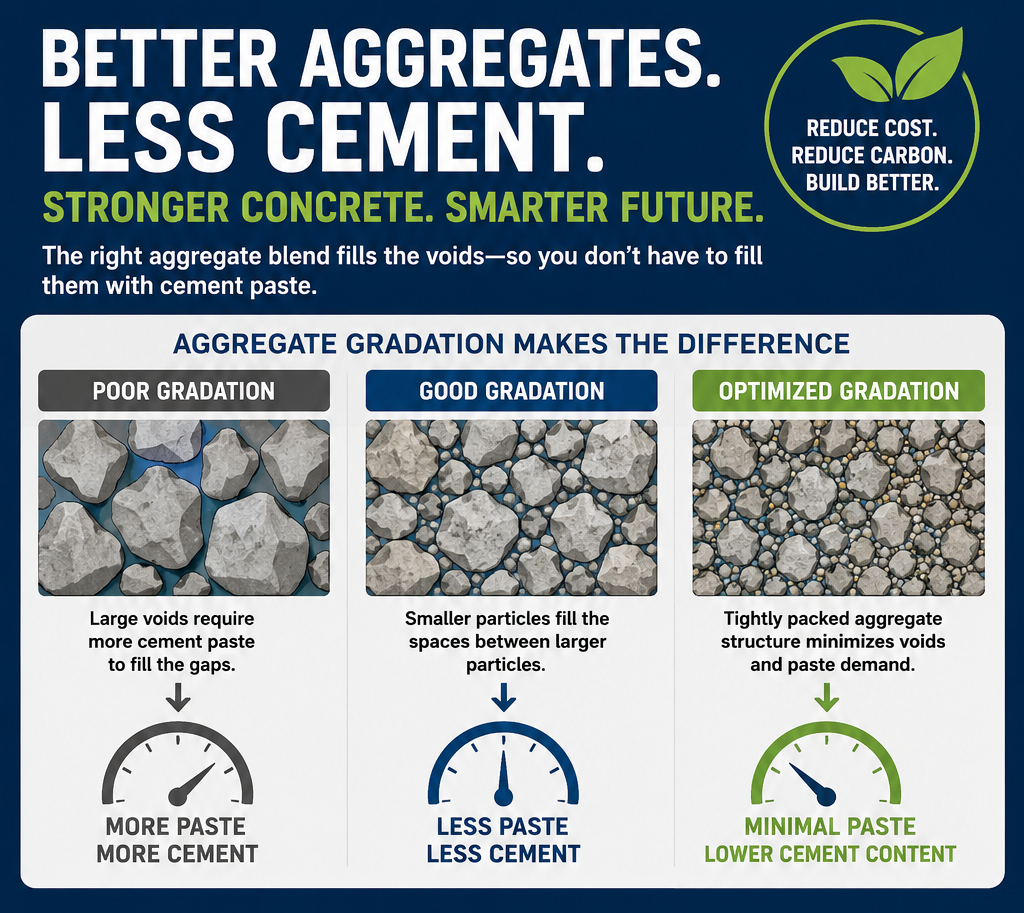
For decades, the concrete industry has generally approached higher-strength concrete in a familiar way: increase the cementitious content. But as cement prices rise and concrete producers face increasing pressure to reduce embodied carbon, the industry is taking a closer look at another question:
What if better aggregate packing could reduce the amount of cement paste required in the first place?
This is not a new concept. Concrete industry researchers, transportation agencies, the National Ready Mixed Concrete Association (NRMCA), the American Concrete Institute (ACI), and regional concrete organizations have studied the relationship between aggregate gradation, particle packing, paste volume and concrete performance for decades.
The implications are particularly important for today’s concrete plants and concrete batch plants.
A modern Ready Mix Concrete producer doesn’t necessarily need to choose between quality, production speed and lower cement consumption. With the right aggregate materials and the ability to precisely proportion and blend them, those goals can become complementary.
That is one of the fundamental ideas behind the Advantage 250™ concrete batch plant from CMQ Engineering USA.
Why Aggregate Gradation Matters
Aggregate makes up approximately 60% to 75% of the volume of conventional concrete, according to the National Ready Mixed Concrete Association. Cement typically represents only about 10% to 15% by volume. That means the aggregate structure isn’t simply a filler surrounding the cement paste. It is the structural skeleton of the concrete.
Consider a container filled with large rocks. Significant spaces remain between those rocks. Add smaller stones and some of those spaces disappear. Add still finer material and additional voids can be filled. Concrete mix design applies essentially the same principle.
When coarse and fine aggregate particles are appropriately proportioned, smaller particles can occupy spaces between larger particles. The objective is to create a dense aggregate structure with fewer voids.
Why does that matter?
Because the voids between aggregate particles have to be filled with something. In concrete, that “something” is largely cement paste. If aggregate packing is inefficient, more paste may be required to surround the aggregate particles, fill voids and provide the desired workability. If the aggregate structure can be optimized, the concrete producer may be able to achieve the required performance with less paste.
And reducing paste demand can create an opportunity to reduce cementitious material.
The objective isn’t simply to use less cement. The objective is to design a more efficient concrete matrix that doesn’t require unnecessary cement paste to compensate for inefficient aggregate packing.
The Research Behind Combined Aggregate Grading
This concept has received considerable attention from the concrete industry. The National Ready Mixed Concrete Association has published research specifically examining the effect of continuous, well-graded combined aggregate grading on concrete performance.
NRMCA’s Research Laboratory lists both Phase A and Phase B studies from 2007:
- Effect of Continuous (Well-Graded) Combined Aggregate Grading on Concrete Performance, Phase A: Aggregate Voids Content (Packing Density)
- Effect of Continuous (Well-Graded) Combined Aggregate Grading on Concrete Performance, Phase B: Concrete Performance
The research is particularly interesting because it provides an important qualification to the aggregate-packing discussion.
Simply having more aggregate sizes does not automatically guarantee maximum packing density.
The NRMCA Phase A research found that well-graded combined aggregates did not necessarily produce lower void content than less-well-graded combinations. In other words, aggregate optimization must be based on the characteristics and proportions of the actual materials being used.
That distinction is critical.
The goal isn’t to put as many different rocks into a concrete mix as possible. The goal is precision.
The producer needs to know what aggregate sizes are available, determine how those materials interact, develop an appropriate combined gradation, and then reproduce that gradation accurately from batch to batch.
That is where the concrete batch plant becomes an important part of the equation.
From Mix Design to Production: The Missing Link
A laboratory technician can develop an optimized aggregate blend on paper. But the concrete plant has to reproduce it. That can be more difficult than it sounds.
Traditional repose-style concrete batch plants typically weigh aggregates sequentially into a common weigh hopper. Aggregate is deposited, accumulated and subsequently discharged. The process works. It has been used successfully throughout the Ready Mix Concrete industry for generations.
But the physical movement of aggregate matters.
Different particle sizes behave differently when they are dropped, accumulated and discharged. Coarse particles, intermediate particles and sand can segregate as they move through conventional material-handling systems.
That means a mix design that is optimized on paper can potentially experience some degree of aggregate separation before the material ever reaches the mixer.
This is one reason the technology behind modern concrete plants is evolving.
Precision Inline Aggregate Blending
The Advantage 250™ concrete batch plant takes a fundamentally different approach.
Instead of sequentially dropping aggregates into a common weigh hopper, the Advantage 250 uses dedicated precision weigh belts beneath individual aggregate bins. Each aggregate is measured independently and simultaneously. The materials are then discharged onto a common collecting conveyor in controlled, layered ribbons.
The result is precision inline aggregate blending.
The Advantage 250 can be configured with three, four, five or additional aggregate bins, allowing producers to use multiple aggregate sizes and tailor the system to their specific mix designs and production requirements.
This is particularly important for producers interested in optimizing combined aggregate gradation.
The plant isn’t merely storing different sizes of aggregate. It is precisely proportioning and blending those sizes as they move through the batching process. That distinction can be significant.
Better Aggregate Packing Can Mean Less Paste
The fundamental relationship is straightforward:
Better aggregate packing → fewer voids → less paste required to fill those voids → potential reduction in cementitious material.
Of course, the exact result depends upon the specific aggregates, mix design, strength requirements, water-cementitious ratio, admixtures, specifications and other variables. There is no universal percentage reduction in cement that can be promised simply because a producer begins using graded aggregates.
But the opportunity is real.
A Federal Highway Administration document discussing combined aggregate grading explains the objective particularly well: combined grading can be used to improve concrete workability at a given water and paste content, or to minimize water and paste content for a given workability, or improve both workability and hardened properties.
That is exactly the direction the Ready Mix Concrete industry needs to be moving.
Instead of asking: “How much cement do we need to make this concrete strong enough?”
The more sophisticated question becomes: “How efficiently can we build the aggregate structure so that we don’t need unnecessary paste in the first place?”
Cement Reduction Is Also a Sustainability Strategy
Reducing cementitious material isn’t merely a cost-control strategy. It can also be an important component of reducing concrete’s environmental footprint.
The Florida Concrete & Products Association, for example, identifies cement manufacturing as a major source of concrete’s carbon footprint and discusses multiple strategies for reducing concrete’s embodied carbon.
This makes aggregate optimization especially interesting.
Supplementary cementitious materials, alternative binders, carbon capture, admixtures and other technologies all have roles to play in reducing concrete’s environmental impact. But one of the simplest strategies may be to avoid using more cement paste than the concrete actually needs. For Ready Mix Concrete producers, that approach can potentially deliver two benefits simultaneously:
Lower material cost + lower embodied carbon.
The Advantage 250™: Built Around Aggregate Control
This is where the Advantage 250™ concrete batch plant becomes particularly interesting for modern Ready Mix Concrete producers. The system was engineered around precision aggregate control.
Each aggregate bin has its own dedicated weigh belt. VFD-controlled belt drives regulate material flow, allowing aggregates to be proportioned simultaneously rather than sequentially. The materials are then combined in ribboned layers on the collecting conveyor.
The Advantage 250’s aggregate system is available in multiple configurations, allowing producers to select the number of aggregate bins appropriate for their operation. That flexibility matters because different markets have different aggregate resources.
A producer in North Carolina or South Carolina may have different aggregate sources and mix-design strategies than a producer in Georgia, Florida, Texas, Virginia, Illinois or Missouri. The equipment needs to accommodate the producer’s materials — not force every producer into the same aggregate strategy.
A Strong Fit for the Southeast and Mid-Atlantic
This technology has particular relevance to producers throughout the Southeast and Mid-Atlantic.
The Carolinas Ready Mixed Concrete Association (CRMCA) represents ready mixed concrete producers and industry suppliers throughout North and South Carolina and specifically promotes education, technical services, environmental sustainability and advances in concrete technology.
The Georgia Ready Mixed Concrete Association (GRMCA) represents Georgia’s Ready Mix Concrete industry and provides education and information to producers throughout the state.
The Virginia Ready Mixed Concrete Association (VRMCA) serves Virginia’s Ready Mix Concrete industry through education, technical assistance and industry resources.
And in Florida, the Florida Concrete & Products Association has specifically addressed sustainability and the challenge of reducing concrete’s carbon footprint.
These regional markets also have something else in common: significant infrastructure, commercial, residential and industrial growth requiring enormous quantities of Ready Mix Concrete. That creates a compelling opportunity for concrete plant manufacturers to provide technology that addresses both production efficiency and material efficiency.
Graded Aggregates Require Precision Concrete Plants
There is an important distinction between having graded aggregates available and being able to use them effectively. A producer may have multiple aggregate sizes in separate stockpiles. That doesn’t automatically create an optimized combined gradation.
The concrete plant must be capable of:
- Storing multiple aggregate sizes.
- Measuring each material accurately.
- Controlling the proportion of each material.
- Combining the materials consistently.
- Minimizing segregation during material handling.
- Reproducing the same blend from batch to batch.
This is where precision batching equipment becomes increasingly important.
The Advantage 250’s individual weigh belts and inline blending system provide the mechanical infrastructure required to make aggregate optimization practical at production scale.
The result is not simply a faster concrete plant. It is a concrete production system capable of giving the ready mix producer greater control over the aggregate structure.
Speed Still Matters
Of course, aggregate optimization isn’t much use if the plant can’t keep up with demand. That’s another area where the Advantage 250™ differs from many conventional concrete batch plants. The Advantage 250 is designed for production rates up to 250 cubic yards per hour. That means the same plant technology that provides precision aggregate proportioning is also designed for high-volume Ready Mix Concrete production.
For producers shopping for concrete plants for sale, that combination is important.
The question shouldn’t simply be: “How many yards per hour can this concrete batch plant produce?”
It should also be: “How efficiently can this concrete batch plant produce the concrete we actually want to sell?”
The Future of Concrete Production Is More Precise
The concrete industry is entering an era in which efficiency means more than producing more yards per hour. Efficiency increasingly means producing better concrete with fewer unnecessary inputs. That means:
- Optimizing water.
- Optimizing cementitious materials.
- Optimizing admixtures.
- And, perhaps most importantly, optimizing the aggregate structure that makes up the majority of the concrete volume.
Research from NRMCA and ACI, along with work by transportation agencies and regional concrete organizations, demonstrates that aggregate gradation and particle packing are legitimate areas of concrete mixture optimization.
The next step is bringing that thinking from the laboratory and mix-design spreadsheet onto the production floor.
That’s what precision inline aggregate blending is designed to do. The Advantage 250™ concrete batch plant from CMQ Engineering USA gives Ready Mix producers the ability to proportion multiple aggregate sizes simultaneously, blend them continuously, minimize segregation and maintain consistent production at high output.
For producers considering new concrete plants, replacement concrete batch plants, or concrete plants for sale, that represents a fundamentally different way of thinking about batching. Don’t simply produce concrete faster. Produce it more intelligently.
Build the aggregate structure first. Then use cement paste to do what it is supposed to do — not to compensate for what the aggregate structure failed to accomplish.
That may be one of the most important opportunities for improving the economics, consistency and sustainability of Ready Mix Concrete production.
Industry Research & Resources
The following organizations and publications provide useful background on aggregate gradation, particle packing, paste volume, mix optimization and Ready Mix Concrete production:
- National Ready Mixed Concrete Association (NRMCA) — Research Laboratory: NRMCA’s research library includes its Effect of Continuous (Well-Graded) Combined Aggregate Grading on Concrete Performance studies. NRMCA Research Laboratory
- NRMCA — About Concrete — Provides basic information on concrete composition, including the typical volumetric contribution of aggregates and cement. NRMCA: About Concrete
- American Concrete Institute (ACI) — Research and educational resources addressing aggregate gradation, mixture proportioning and paste volume. ACI
- Federal Highway Administration (FHWA) — Research addressing combined aggregate grading and its ability to improve workability or reduce water and paste requirements. FHWA: Combined Aggregate Grading Research
- Carolinas Ready Mixed Concrete Association — Industry organization serving North and South Carolina and promoting technical education, innovation and environmental sustainability. Carolinas Ready Mixed Concrete Association
- Georgia Ready Mixed Concrete Association — State association representing Georgia’s Ready Mix Concrete industry. Georgia Ready Mixed Concrete Association
- Virginia Ready Mixed Concrete Association — Trade association supporting the Virginia Ready Mix industry through education, technical assistance and industry resources. Virginia Ready Mixed Concrete Association
- Florida Concrete & Products Association — Resources addressing sustainability and reducing the carbon footprint of concrete. Florida Concrete & Products Association: Sustainability
- CMQ Engineering USA — Advantage 250™ — Technical information on the Advantage 250’s precision inline aggregate blending, dedicated weigh belts, aggregate configurations and 250-cubic-yard-per-hour production capability. Advantage 250™ Concrete Batch Plant