
Rethinking the Process of Making Concrete
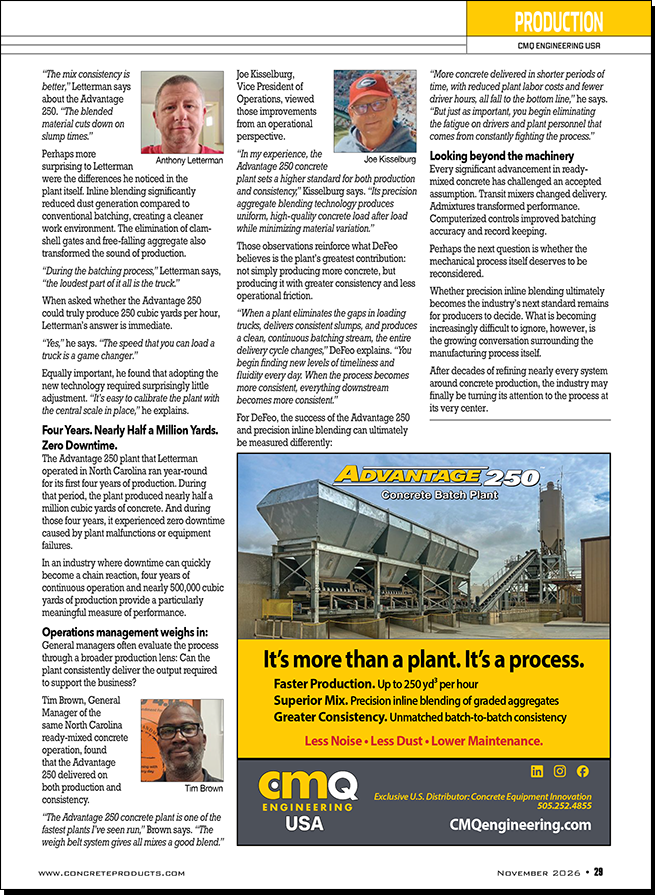
Our article, “Rethinking the Process of Making Concrete,” ran in the November 2026 issue of Concrete Products magazine. You can read the article in its entirety below, or click here to download the pdf.
Every concrete producer understands the relentless pace of the business. Trucks are waiting. Dispatch is changing orders. Customers want one more load, and they want it right now. Every minute counts, and every delay compounds.
For decades, the ready mix industry has responded to these pressures by asking more of its people. Longer hours. More overtime. More maintenance deferred until tomorrow.
Yet there is an interesting irony when it comes to improving the efficiency of daily operations: While dispatch software and plant controls have become more sophisticated, the mechanical process of batching concrete has changed surprisingly little.
One veteran industry executive believes this reality has become so familiar, that many producers no longer question it.
“My first impressions of this industry were that of fatigue,” recalls Dave DeFeo. “Bone-tired people working 80 or 90 hours a week, year after year. It left an impression on me that I’ve spent my career trying to change.”
After more than four decades in the ready-mixed concrete industry, DeFeo has become convinced that many of the stresses accepted as unavoidable by producers, are not simply the cost of doing business. Instead, they are often symptoms of a process that has remained largely unchanged for generations.
Building a better process
In the late 2010s, DeFeo helped spearhead the development of a precision inline blending concrete batch plant that challenged many of the industry’s long-held assumptions about how concrete should be batched. Field installations consistently produced concrete with exceptional uniformity, strength, and finishability.
More importantly, they demonstrated that the batching process itself — not merely faster computers or better automation — could fundamentally change the way ready-mixed concrete is produced.
“It was the results — not merely the theory — that changed my perspective,” DeFeo says. “I realized the opportunity wasn’t simply building a better batch plant. It was building a better process.”
When DeFeo returned to managing ready-mix operations, his search for innovation never stopped. Having witnessed the capabilities of precision inline blending firsthand, he became convinced that the process represented one of the industry’s greatest opportunities for advancement. He began searching for a manufacturer that shared the same philosophy while advancing the concept even further. That search eventually led him to an Australian company, CMQ Engineering.
For American producers encountering the CMQ name for the first time, the company’s background is important context.
Established in 1964, CMQ Engineering has spent more than six decades designing and manufacturing industrial equipment for concrete production, mining, and quarrying operations. That breadth of experience has made CMQ Engineering Australia’s leading supplier of concrete batching plants.
For DeFeo, that history was significant. He wasn’t looking for a manufacturer interested simply in putting a different shape of equipment on the market. He was looking for an engineering company with the experience to understand why a different batching process worked — and the manufacturing capability to refine it. That philosophy lies at the heart of the Advantage 250™ concrete batch plant.
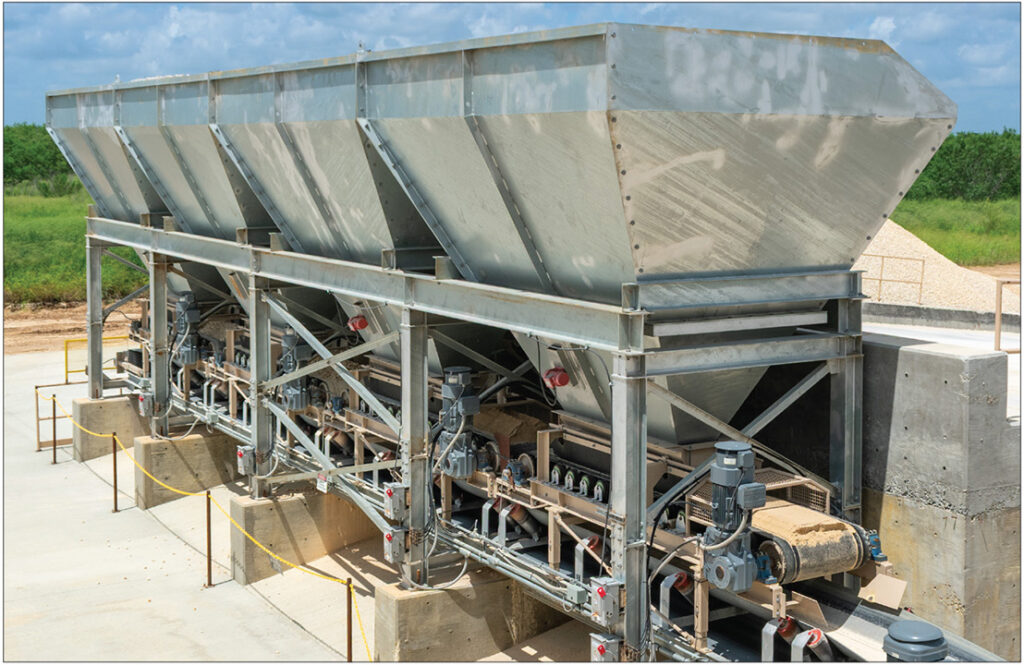
How the process works:
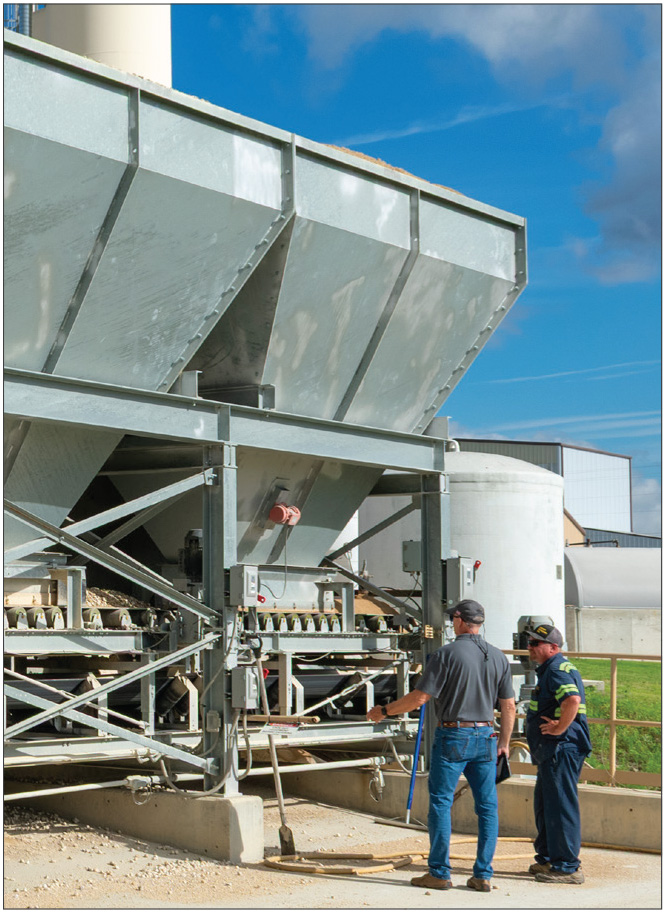
Traditional concrete plants weigh aggregates one material at a time. Blending doesn’t begin until those materials are inside the mixer drum. The Advantage 250 approaches the process differently. Dedicated precision weigh belts simultaneously meter every aggregate in the mix design, layering the materials into a continuous ribboned stream on the charging conveyor. By the time the material reaches the mixer truck, the aggregates have already been proportioned and blended together.
Importantly, the Advantage 250 is not a loss-in-weight batching system. Like conventional batch plants, it weighs the aggregate quantities required for each mix, but uses precision weigh belts for each aggregate, rather than a shared weigh hopper.
Where theory meets production
Engineering concepts often sound impressive on paper. Plant operators, however, judge equipment by whether it makes the day easier. After more than 20 years in North Carolina’s ready-mixed concrete industry, Anthony Letterman has ample experience to make that judgment.
“The mix consistency is better,” Letterman says about the Advantage 250. “The blended material cuts down on slump times.” Perhaps more surprising to Letterman were the differences he noticed in the plant itself. Inline blending significantly reduced dust generation compared to conventional batching, creating a cleaner work environment. The elimination of clam-shell gates and free-falling aggregate also transformed the sound of production.
“During the batching process,” Letterman says, “the loudest part of it all is the truck.”
When asked whether the Advantage 250 could truly produce 250 cubic yards per hour, Letterman’s answer is immediate. “Yes,” he says. “The speed that you can load a truck is a game changer.”
Equally important, he found that adopting the new technology required surprisingly little adjustment. “It’s easy to calibrate the plant with the central scale in place,” he explains.
Four Years. Nearly Half a Million Yards. Zero Downtime.
The Advantage 250 plant that Letterman operated in North Carolina ran year-round for its first four years of production. During that period, the plant produced nearly half a million cubic yards of concrete. And during those four years, it experienced zero downtime caused by plant malfunctions or equipment failures.
In an industry where downtime can quickly become a chain reaction, four years of continuous operation and nearly 500,000 cubic yards of production provide a particularly meaningful measure of performance.
Operations management weighs in:
General managers often evaluate the process through a broader production lens: Can the plant consistently deliver the output required to support the business?
Tim Brown, General Manager of the same North Carolina ready-mixed concrete operation, found that the Advantage 250 delivered on both production and consistency.
“The Advantage 250 concrete plant is one of the fastest plants I’ve seen run,” Brown says. “The weigh belt system gives all mixes a good blend.”
Joe Kisselburg, Vice President of Operations, viewed those improvements from an operational perspective.
“In my experience, the Advantage 250 concrete plant sets a higher standard for both production and consistency,” Kisselburg says. “Its precision aggregate blending technology produces uniform, high-quality concrete load after load while minimizing material variation.”
Those observations reinforce what DeFeo believes is the plant’s greatest contribution: not simply producing more concrete, but producing it with greater consistency and less operational friction.
“When a plant eliminates the gaps in loading trucks, delivers consistent slumps, and produces a clean, continuous batching stream, the entire delivery cycle changes,” DeFeo explains. “You begin finding new levels of timeliness and fluidity every day. When the process becomes more consistent, everything downstream becomes more consistent.”
For DeFeo, the success of the Advantage 250 and precision inline blending can ultimately be measured differently:
“More concrete delivered in shorter periods of time, with reduced plant labor costs and fewer driver hours, all fall to the bottom line,” he says. “But just as important, you begin eliminating the fatigue on drivers and plant personnel that comes from constantly fighting the process.”
Looking beyond the machinery
Every significant advancement in ready-mixed concrete has challenged an accepted assumption. Transit mixers changed delivery. Admixtures transformed performance. Computerized controls improved batching accuracy and record keeping.
Perhaps the next question is whether the mechanical process itself deserves to be reconsidered. Whether precision inline blending ultimately becomes the industry’s next standard remains for producers to decide. What is becoming increasingly difficult to ignore, however, is the growing conversation surrounding the manufacturing process itself.
After decades of refining nearly every system around concrete production, the industry may finally be turning its attention to the process at its very center.