
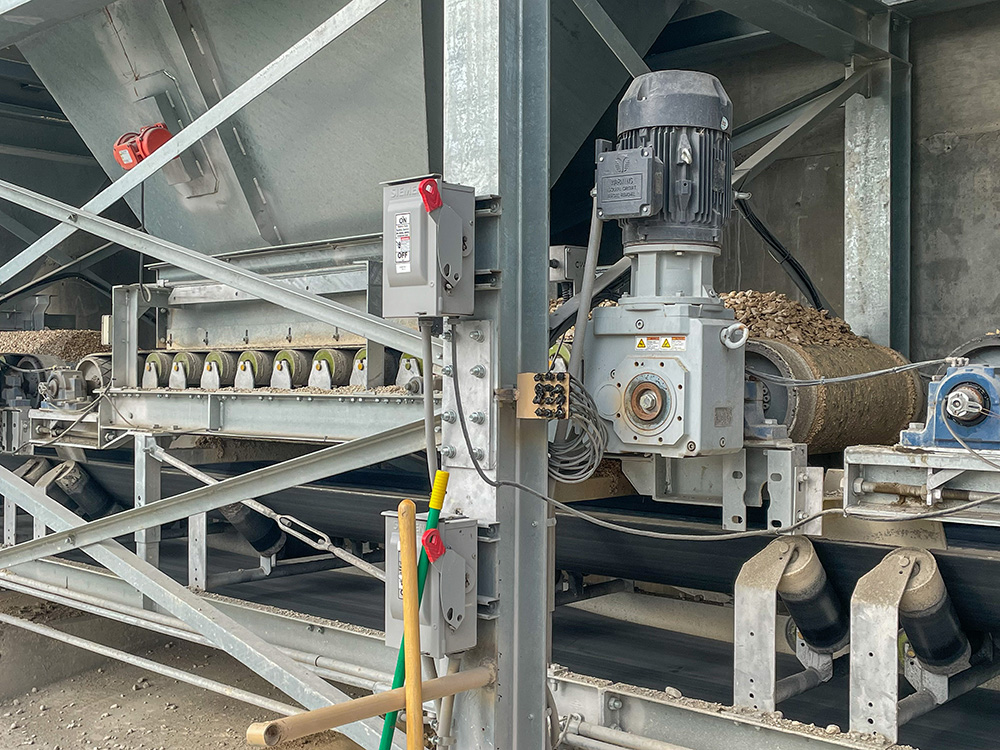
In concrete production, consistency isn’t just a goal — it’s the foundation of quality. For decades, traditional repose batching plants have relied on gravity: aggregates are dropped one at a time into a weigh hopper, measured, and then discharged. It’s a familiar system, but one that introduces variability at every step — from inconsistent material flow to segregation during free fall. Today, innovations like precision belt weighers — as used in the CMQ Engineering Advantage 250 Concrete Batch Plant — are redefining what accuracy and consistency really look like.
The Problem with Repose Batching
Traditional batching relies on sequential weighing. One aggregate is dropped, weighed, stopped, then the next is added. This stop-and-start process creates inefficiencies and opens the door to inconsistency. Moisture variations are harder to control, and each batch becomes slightly different from the last. Even more importantly, repose systems depend on gravity — meaning materials are in free fall, which increases dust, noise, and wear on equipment. Over time, weigh hoppers and discharge gates become maintenance-heavy components, adding cost and downtime to plant operations.
The Belt Weigher Advantage
Precision belt weighers flip that process on its head. Instead of stopping and starting, aggregates are continuously measured in motion as they move along a conveyor belt. This allows for real-time, highly accurate proportioning of materials — even with difficult or inconsistent aggregates. In the Advantage 250™, each aggregate bin feeds onto its own dedicated belt weigher, enabling all materials to be measured simultaneously rather than sequentially. The result is a smoother, more controlled flow of material — and far greater batching accuracy.
Because the material is constantly moving, belt weighers also prevent common issues like bridging or uneven discharge from bins. The belt itself provides a natural agitation, keeping aggregates flowing evenly and eliminating the inconsistencies often seen in gravity-fed systems.
Inline Blending vs. Layered Guesswork
One of the biggest breakthroughs comes from how these weighers integrate with in-line aggregate blending. Instead of dumping materials separately and hoping they mix properly later, the Advantage 250™ blends aggregates in precisely controlled, ribboned layers before they ever reach the mixer. As each material is introduced onto the conveyor, it forms a layered, uniform blend — sand and stone working together from the start. This approach:
- Minimizes segregation and voids
- Improves uniformity across every batch
- Reduces reliance on extended mixing time
Compared to repose batching, where materials are combined after free fall, this is a fundamental shift. It’s not just batching — it’s engineered blending.
Consistency You Can Measure — and Trust
The real value of belt weighers shows up in the finished product. With more accurate proportioning and better aggregate distribution, producers see:
- Stronger concrete performance
- Tighter batch-to-batch consistency
- Reduced cement variability and cost
- Improved quality control and testing results
Because every material is measured continuously and blended uniformly, there’s less guesswork — and fewer surprises in the field.
Efficiency Beyond the Mix
Precision belt weighers don’t just improve quality — they improve operations. By eliminating weigh hoppers and clamshell discharge gates, plants benefit from:
- Lower maintenance requirements
- Reduced noise and dust
- Smoother, continuous production flow
- Higher throughput with fewer interruptions
In the Advantage 250™, this translates into production rates up to 250 yards per hour, with faster truck loading and fewer delays on large pours.
A Shift from Batching to Process Control
At its core, the difference between belt weigher systems and repose batching comes down to control. Repose batching measures materials in isolated steps. Belt weighers measure them as part of a continuous, integrated process. That shift — from static measurement to dynamic control — is what allows modern plants like the Advantage 250™ to deliver concrete that is not only faster to produce, but more consistent, more efficient, and ultimately more reliable.
Because in today’s concrete production, it’s not enough to batch materials.
You have to control the process — from the first aggregate to the final mix.