
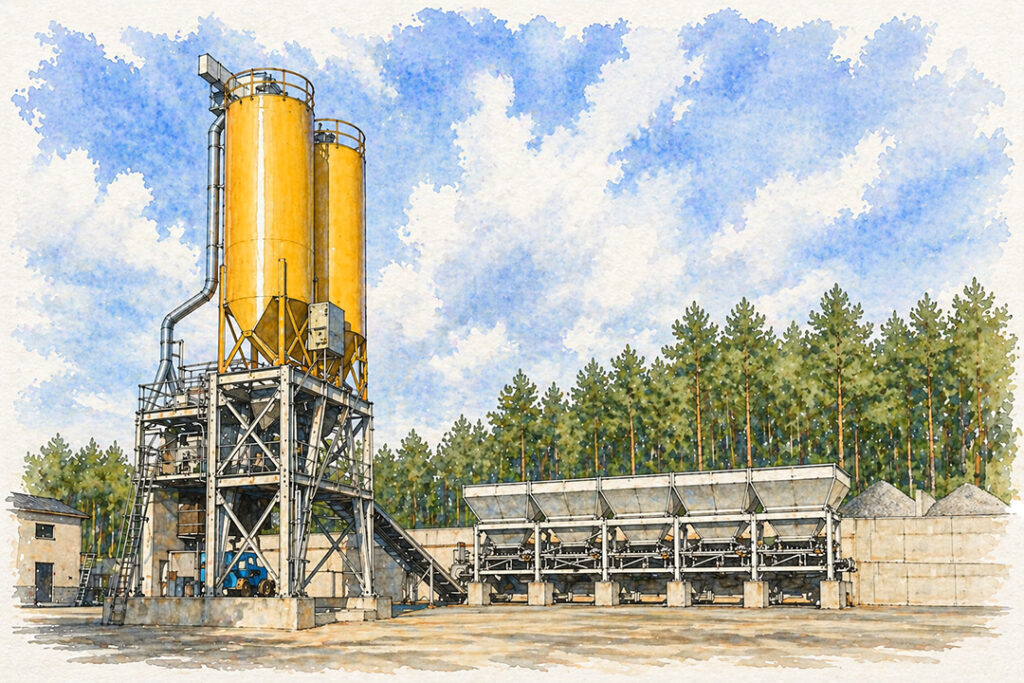
In today’s construction environment, consistency isn’t just preferred — it’s essential. The difference between average concrete and high-performance concrete often comes down to how it’s produced. That’s where Advantage 250™ concrete batch plant’s precision inline blending changes the game.
Reduced Segregation
One of the most significant advantages of inline blending is how it handles aggregate distribution. Because materials are blended continuously as they move through the system, aggregates remain evenly distributed throughout the process.
This minimizes the separation of coarse and fine materials — a common issue in traditional batching methods—and ensures the mix stays uniform before it even reaches the mixer. The result is a more cohesive, predictable concrete from the very beginning.
Improved Consistency
Inline blending replaces step-by-step batching with a continuous, controlled process. Each material is measured in real time, with flow rates constantly monitored and adjusted. At the same time, aggregates are layered uniformly as they move along the blending system.
This combination of continuous measurement, real-time control, and uniform layering produces exceptionally consistent results. Batch-to-batch variability is significantly reduced, giving contractors and engineers greater confidence in the material they’re placing.
Better Structural Performance
Consistency at the material level directly translates to performance in the field. When aggregates are evenly distributed, the concrete matrix becomes denser and more uniform.
This leads to:
- Fewer internal voids
- Improved density
- Higher compressive strength potential
- Greater long-term durability
In practical terms, that means concrete that performs better under load, resists wear more effectively, and holds up longer in demanding environments.
Increased Production Efficiency
Beyond quality improvements, inline blending also enhances production efficiency. Unlike traditional repose batching, where materials are processed one at a time, inline systems handle multiple materials simultaneously.
Weighing and blending occur concurrently, streamlining the entire operation and reducing overall batching time. The result is faster production without sacrificing quality—an increasingly important advantage on today’s fast-paced job sites.
Built for Performance from the Start
Inline blending doesn’t just improve one aspect of concrete production — it improves the entire process. By addressing segregation, consistency, structural integrity, and efficiency all at once, it delivers a product that is engineered for performance before it ever reaches the truck.
In an industry where precision matters, that’s not just an upgrade—it’s a fundamental shift in how concrete is made.