
When producers think about improving concrete quality, most conversations focus on mix design, admixtures, and of course, aggregate gradation. But one of the most overlooked contributors to batching consistency inside a modern ready mix concrete plant is the movement and storage of cementitious materials themselves.
As today’s concrete mixes increasingly incorporate supplementary cementitious materials such as fly ash and other pozzolanic materials, the efficiency and reliability of cement handling systems become even more important.
Portland Cement, Fly Ash, and Modern Concrete Production
Portland cement remains the foundation of modern concrete production, but many ready mix producers now incorporate pozzolanic materials like fly ash to improve durability, workability, and long-term performance characteristics. These supplementary materials can also help reduce permeability, mitigate heat generation, and improve overall mix efficiency.
That means a modern concrete batch plant must do more than simply store cement. It must consistently deliver multiple powdered materials accurately, efficiently, and without interruption.
Unfortunately, traditional silo designs can create problems over time.
The Hidden Problem with Traditional Cement Silos
In many conventional batching systems, older cement or fly ash can cling to silo walls while fresher material funnels downward through the center. This creates uneven discharge patterns, inconsistent material flow, and the possibility of aged material remaining inside the silo for extended periods.
For a high-output ready mix concrete plant, inconsistent cement flow can impact:
- Batch cycle times
- Material accuracy
- Mix consistency
- Equipment maintenance
- Production efficiency
As production demands increase, these issues become more noticeable — especially in busy operations loading trucks continuously throughout the day.
The Advantage 250™ and CMQ Engineering’s Fast Cement™ System
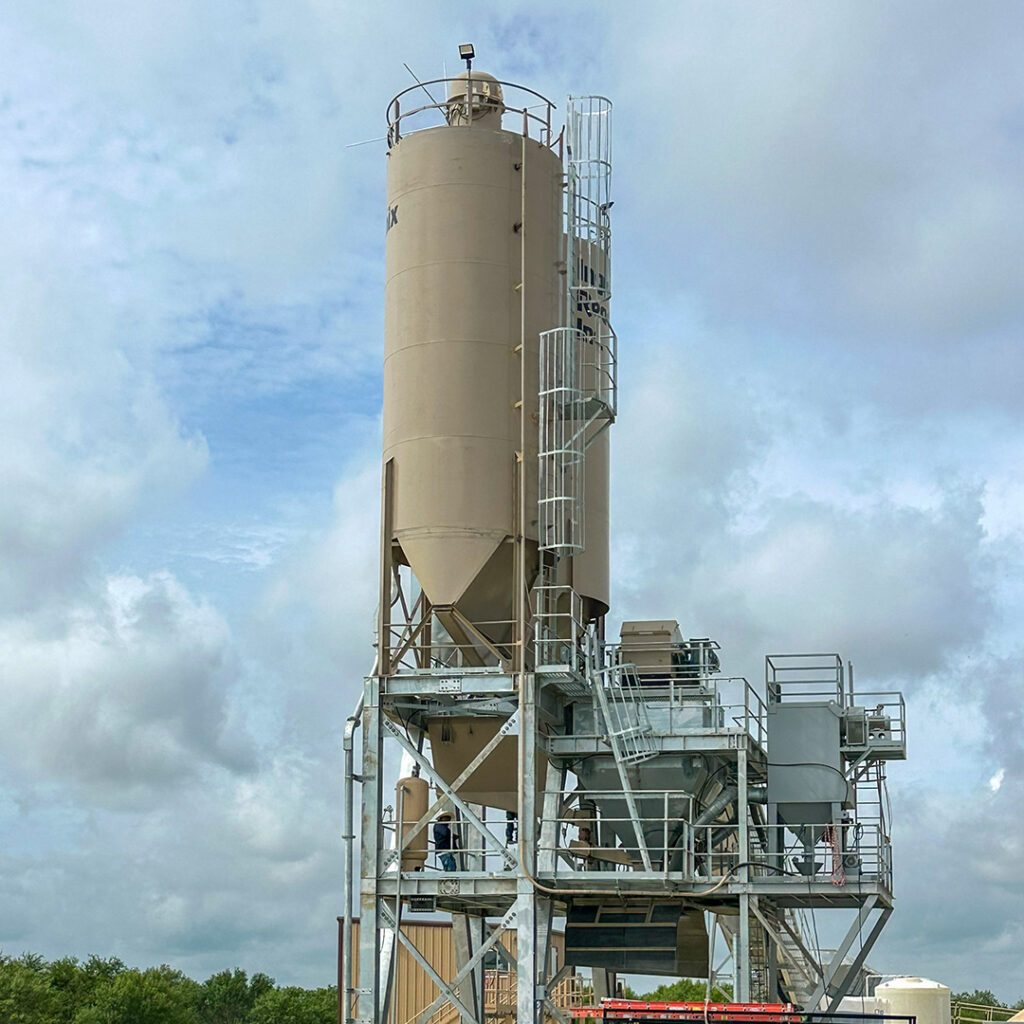
The Advantage 250™ concrete batch plant from CMQ Engineering USA addresses this challenge through its Fast Cement™ chisel-nose silo design. Unlike conventional cone-bottom silos, the chisel-nose geometry promotes true first-in, first-out cement flow.
The result is faster, more even discharge with less material buildup and reduced risk of stale cement remaining in the system.
A standard Advantage 250™ ready mix concrete plant includes two 100-ton chisel-nose silos — commonly configured with one silo dedicated to Portland cement and the other to fly ash. This allows producers to efficiently manage modern mix designs while maintaining fast, consistent batching performance.
More Than Storage — A Fully Integrated Concrete Production System
The chisel-nose silos are only one component of the Advantage 250™ system. The plant also incorporates:
- Precision inline aggregate blending
- Individual VFD-controlled weigh belts
- Reduced material segregation
- Lower dust and noise levels
- Faster truck loading capacity
- High-volume production up to 250 yd³/hr
Unlike traditional gravity-fed batching systems, the Advantage 250™ blends aggregates continuously in ribboned layers before reaching the truck, creating a more uniform concrete mixture with improved consistency from load to load.
Built for the Future of Ready Mix Concrete Production
Concrete producers today face growing pressure to improve consistency, increase throughput, reduce maintenance, and accommodate more advanced concrete mix designs. That requires more than incremental upgrades — it requires a smarter batching process.
The Advantage 250™ was engineered to meet those demands head-on.
From precision aggregate blending to first-in, first-out cement handling, every component of the system is designed to help producers operate a more efficient, reliable, and profitable ready mix concrete plant.
To learn more about the Advantage 250™ concrete batch plant and CMQ Engineering’s Fast Cement™ system, click here.