
Why Aggregate Control Matters in a Modern Ready Mix Concrete Plant
In the concrete industry, conversations about mix quality often focus on cement content, admixtures, or compressive strength. But long before cement ever reaches the truck, one of the most important factors in concrete consistency is already taking shape:
Aggregate gradation.
Inside every high-performing ready mix concrete plant, the ability to precisely manage aggregate sizes and proportions plays a major role in workability, pumpability, finishability, yield consistency, and overall concrete performance.
That’s why the aggregate blending system matters.
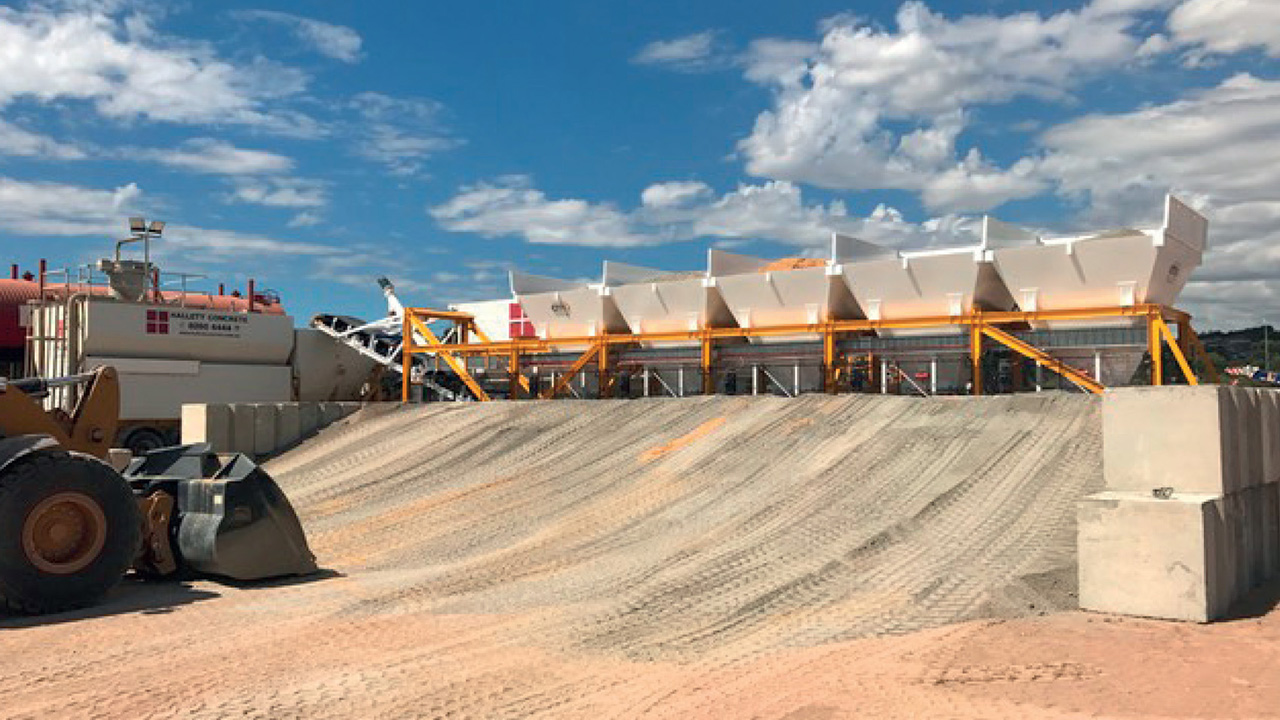
At CMQ Engineering USA, the Advantage 250™ concrete batch plant was engineered around precision inline blending — giving producers greater control over aggregate distribution before materials ever enter the batching process.
Why Aggregate Gradation Matters
Concrete is not simply “cement and rock.” Aggregate makes up the majority of the mix volume, and the way those materials combine has a direct impact on the finished product.
Poor aggregate gradation can contribute to:
- Increased segregation
- Inconsistent workability
- Excess cement demand
- Reduced finish quality
- Variable yield performance
- Difficult pumping characteristics
Well-controlled aggregate blending helps producers create a more uniform and stable concrete mix while improving batching consistency from load to load.
In many traditional batch plants, aggregates are introduced in larger, less-controlled material flows. The Advantage 250™ approaches the process differently.
Precision Inline Aggregate Blending
The Advantage 250™ utilizes individual VFD-controlled weigh belts that continuously meter aggregates into a ribboned inline blending process. Instead of relying solely on gravity-fed batching, the system layers aggregates in controlled proportions before loading.
The result is:
- Reduced material segregation
- More consistent aggregate distribution
- Improved batching accuracy
- Faster production capability
- Better overall concrete uniformity
This is especially valuable in today’s market, where producers often manage multiple mix designs for residential, commercial, DOT, and specialty concrete applications.
Why Multiple Aggregate Bin Configurations Matter
The Advantage 250™ can be configured with 3-bin, 4-bin, or 5-bin aggregate blending systems, depending on the operational needs of the producer.
Actually, even more bins are available… but this isn’t simply about “more bins.”
It’s about giving concrete producers greater flexibility and tighter control over aggregate gradation strategies.
Different operations require different capabilities:
- High-volume producers may prioritize streamlined throughput
- DOT-focused operations may require tighter aggregate control
- Specialty mix producers may need additional aggregate combinations
- Expanding markets may demand greater mix design versatility
Additional aggregate bins allow producers to fine-tune material proportions while efficiently handling a wider range of mix designs without sacrificing production speed.
Built for the Modern Concrete Producer
Today’s ready mix producers face increasing pressure to improve consistency, maximize efficiency, and adapt to changing market demands.
The Advantage 250™ concrete batch plant was designed to meet those challenges head-on.
From precision inline aggregate blending to configurable multi-bin systems, every component is engineered to help producers create more consistent concrete with greater operational flexibility.
Because at the end of the day, concrete quality starts long before the cement hits the truck.
It starts with the gradation feeding it.