

The ready mix concrete industry has changed dramatically over the past decade. Customers expect more than standard residential concrete—they demand specialty mixes, faster delivery, greater consistency, and dependable quality on every load. At the same time, producers face increasing pressure to improve productivity while controlling operating costs.
For many ready mix concrete plants, meeting these demands requires more than increasing production capacity. It requires expanding production capability.
One of the most effective ways to accomplish that is by incorporating a twin shaft mixer, also known as a pugmill, into the production process.
Expand Beyond Conventional Ready Mix Concrete
Most ready mix batch plants are designed primarily for transit-mixed concrete. While this approach works well for many applications, today’s producers often have opportunities to supply additional products that require more intensive mixing.
A twin shaft mixer allows a plant to expand into markets such as:
- Roller Compacted Concrete (RCC)
- Cement Treated Base (CTB)
- Central mix (wet batch) concrete
- Specialty concrete mixes
- High-performance concrete applications
Rather than limiting your operation to traditional ready mixed concrete, a twin shaft mixer opens the door to new customers and additional revenue streams.
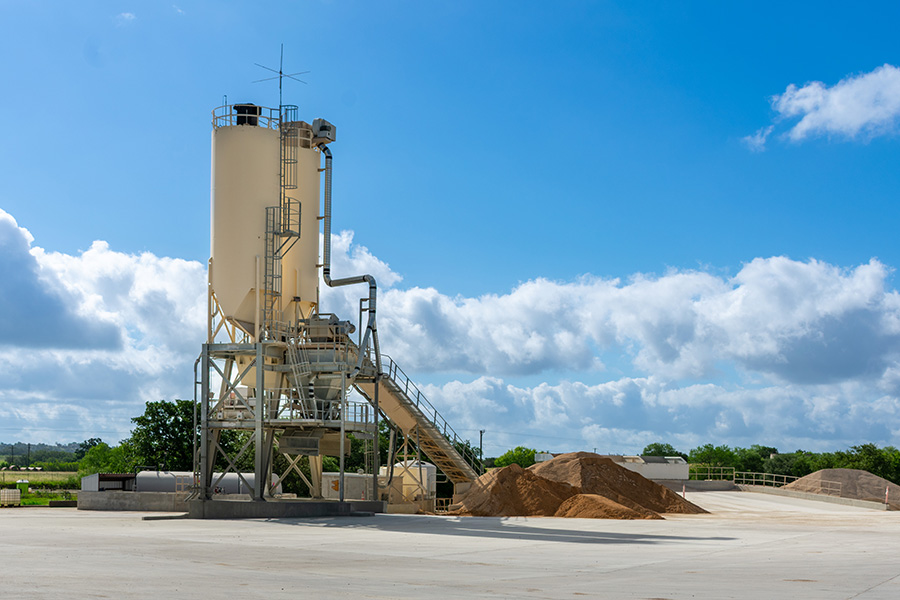
Most ready mix batch plants are designed primarily for transit-mixed concrete. While this approach works well for many applications, today’s producers often have opportunities to supply additional products that require more intensive mixing.
A twin shaft mixer allows a plant to expand into markets such as:
- Roller Compacted Concrete (RCC)
- Cement Treated Base (CTB)
- Central mix (wet batch) concrete
- Specialty concrete mixes
- High-performance concrete applications
Rather than limiting your operation to traditional ready mixed concrete, a twin shaft mixer opens the door to new customers and additional revenue streams.
Produce Roller Compacted Concrete (RCC)
Demand for Roller Compacted Concrete continues to grow for industrial yards, ports, heavy-duty pavements, and infrastructure projects. RCC is a stiff, low-slump concrete that requires high-energy mixing to achieve consistent distribution of cement and moisture throughout the mix.
Because of its aggressive counter-rotating mixing action, a twin shaft mixer is particularly well suited for RCC production. Transportation agencies and industry guidance commonly recommend twin shaft mixers because they provide the mixing energy needed for these very low-slump mixtures while maintaining uniformity and production efficiency.
For producers interested in entering the RCC market, the right mixer can become a significant competitive advantage.
Add Cement Treated Base (CTB) to Your Product Line
Many contractors prefer purchasing CTB from an established ready mix concrete plant rather than operating portable mixing equipment on-site.
A twin shaft mixer makes producing CTB practical because it rapidly blends aggregates, cement, and moisture into a consistent mixture suitable for road construction, parking lots, industrial developments, and infrastructure projects.
Offering CTB allows producers to serve civil contractors, municipalities, and DOT projects while generating additional plant utilization during slower ready mix production periods.
Serve Customers Who Prefer Central Mix Concrete
Not every project is best served by transit-mixed concrete.
Many commercial, precast, architectural, and infrastructure projects specify central mix concrete (also called wet batch concrete) because the concrete is completely mixed before leaving the plant. This provides exceptional consistency from truck to truck and reduces variability caused by differences in truck mixing times.
Twin shaft mixers are widely used as the heart of central mix concrete plants because they provide intense mixing action, rapid cycle times, and highly uniform concrete that meets demanding specifications.
For ready mix producers, adding central mix capability can create opportunities to supply projects requiring tighter quality control and specialized concrete mixes.
Improve Concrete Quality and Consistency
Concrete quality begins with mixing.
Twin shaft mixers use two synchronized horizontal shafts equipped with mixing paddles that continuously move material in multiple directions throughout the mixing chamber. This compulsory mixing action creates excellent homogeneity while reducing dead zones that can occur with less aggressive mixing systems.
The result is:
- More consistent concrete
- Better distribution of cement and admixtures
- Improved batch-to-batch uniformity
- Reliable performance across a wide range of mix designs
These advantages become even more important when producing specialty concrete, self-consolidating concrete (SCC), RCC, and other demanding applications.
Increase Plant Versatility
Perhaps the greatest advantage of a twin shaft mixer is flexibility.
Instead of operating a ready mix concrete plant capable of producing only conventional transit-mixed concrete, producers gain equipment capable of supporting multiple product lines from the same facility.
That flexibility can help plants:
- Win larger commercial projects
- Serve public infrastructure work
- Expand into industrial markets
- Differentiate themselves from competitors
- Generate new revenue without building an entirely new production facility
The CMQ Engineering Difference
At CMQ Engineering, we’ve designed our Twin Shaft Mixer / Pugmill to help modern ready mix concrete plants do more than simply produce concrete. We’ve engineered it to help producers expand their capabilities, improve product quality, reduce maintenance, and increase profitability.
Whether you’re interested in producing traditional ready mixed concrete, Roller Compacted Concrete, Cement Treated Base, or central mix concrete, the CMQ Engineering Twin Shaft Mixer delivers the performance, reliability, and continuous mixing action needed to keep your operation productive.
Because today’s most successful ready mix producers aren’t simply making more concrete.
They’re producing more opportunities.